Sewer Line System Lifespan: Signs It’s Time to Inspect
Your sewer line system will not last forever, but age alone does not tell you when there is a problem. Pipe material, roots, soil conditions, installation quality, and past maintenance all affect how well a sewer line holds up underground.
Bee Quick Plumbing & Sewer works with homeowners in Naperville and surrounding areas on sewer problems ranging from stubborn clogs to damaged underground lines. We believe the right place to start is figuring out what is actually happening before deciding what work makes sense.
You also do not have to wait for sewage to back up into your home. Slow drains, recurring clogs, gurgling, odors, and changes in the yard can appear earlier. Knowing how these signs fit together can help you decide when a sewer inspection is worth considering.
How Long Can a Sewer Line System Last?
There is no exact expiration date for a residential sewer line. Two pipes installed around the same time can be in very different condition today because pipe material is only one part of the picture.
Published service-life estimates also vary by source. The ranges below are broad planning estimates based on commonly cited industry life-expectancy guidance, including the International Association of Certified Home Inspectors’ estimated life-expectancy chart. Actual service life can be shorter or longer depending on the pipe and the conditions around it.
| Pipe Material | Approximate Planning Range |
|---|---|
| Clay pipe | 50–100+ years |
| Cast iron | 50–75+ years |
| Orangeburg | 30–50 years |
| PVC | 75–100+ years |
| Concrete | 50–100+ years |
These figures are better treated as planning ranges than replacement deadlines. A pipe near the upper end of an estimated lifespan does not automatically need replacement, and a newer line is not automatically free from damage.
What Affects the Sewer Line System Lifespan?
Conditions around the pipe can matter just as much as the material. Moving soil can stress joints, while tree roots can enter cracks, gaps, and other weak areas and gradually restrict the pipe.
Installation quality, previous repairs, maintenance history, water use, and buildup inside the line also affect its condition. If you do not know the age or history of your sewer, an inspection can tell you more about its current condition than an age estimate alone.
We would rather understand the condition of the line before deciding what kind of work it needs. A sewer that needs cleaning or a localized repair should not automatically be treated like a collapsed line that requires much more extensive work.
Why Problems Underground Can Stay Hidden
Most of the sewer line is buried, which makes deterioration easy to miss. Unlike a dripping faucet or leaking connection under a sink, you cannot simply look at the pipe and see what is changing.
That is why a sewage backup should not be treated as the first meaningful warning sign. Drainage can start behaving differently well before wastewater reaches the point of backing up into the home.
The pattern of those changes matters. One slow bathroom sink may have a local buildup of hair or soap, while several slow fixtures can point to a restriction farther down the drainage system.
Recurring symptoms deserve even more attention. If a clog is cleared but returns, we want to understand why it keeps coming back instead of assuming that every recurrence is a separate problem.
8 Warning Signs Worth Taking Seriously
No single symptom proves that the main sewer is failing. The number of affected fixtures, how often the problem returns, and what is happening elsewhere on the property give us much better clues.
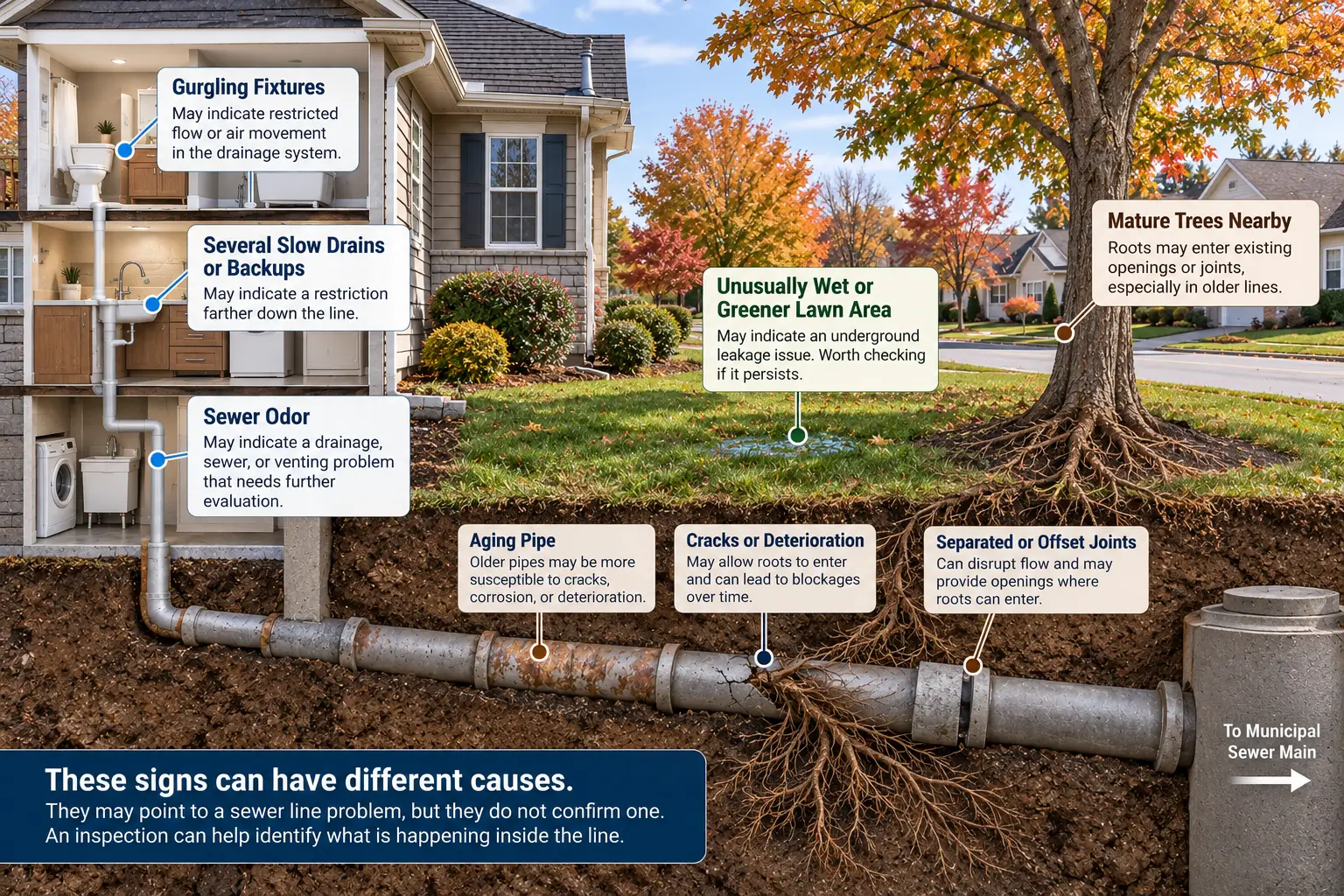
Watch for these eight signs:
- Frequent drain backups
A blockage that keeps returning can mean the original cause was never fully addressed. Backups affecting several fixtures make a problem farther down the system more likely.
- Several slow drains
One slow sink may have a local clog. If sinks, showers, toilets, or floor drains start slowing down together, the restriction may be deeper in the system.
- Gurgling toilets or drains
Gurgling can occur when water and air are not moving normally through the drainage piping. The sound alone does not identify the cause, but it becomes more meaningful when paired with slow drainage or backups.
- Sewer odors indoors or outside
Persistent sewage smells can come from drainage, trap, venting, or sewer problems. Where and when you smell the odor helps narrow down what should be checked.
- An unusually green area of grass
One section of lawn growing differently from the surrounding area deserves attention, especially near the sewer route. Irrigation and soil conditions can cause similar changes, so greener grass by itself does not prove that a sewer is leaking.
- Wet ground during dry weather
A persistently wet area without recent rain or irrigation can justify a closer look when it appears near buried plumbing.
- Mature trees near the sewer route
Roots can reach damaged joints, cracks, and openings in buried piping. Once inside, continued growth can restrict wastewater flow.
- An older home with an unknown sewer history
If you do not know the pipe material, whether previous repairs were made, or when anyone last inspected the line, you have less information for judging its condition.
The important part is not checking boxes until you reach a certain number. We look at how the symptoms relate to one another.
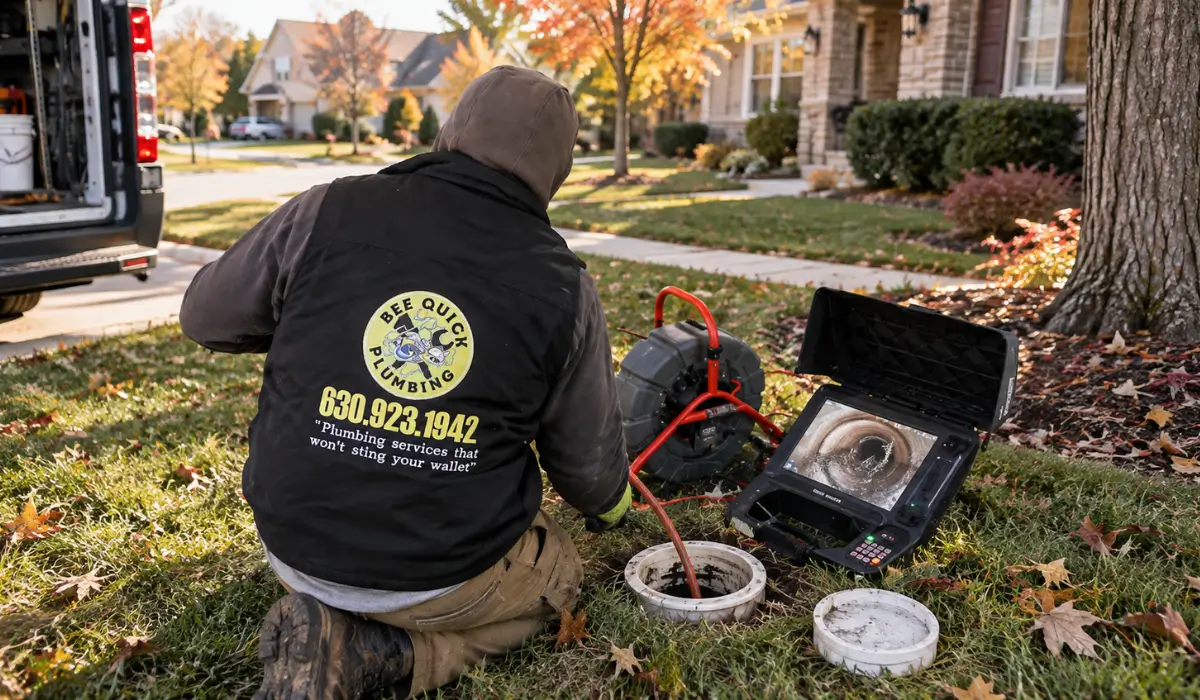
When several signs point toward an underground problem, a sewer camera inspection can let us look inside accessible sections of the line rather than guessing from symptoms alone.
What Causes Buried Sewer Pipes to Fail?
A recurring sewer problem can have several causes, and each one can require a different response. Clearing a blockage may restore drainage, but it will not repair a broken joint or cracked pipe underneath that blockage.
Common problems include:
- Tree root intrusion: Roots can enter cracks, gaps, or weak joints and restrict the inside of the pipe as they grow.
- Aging materials: Older pipes can corrode, crack, deform, or otherwise deteriorate.
- Ground movement: Shifting soil can place stress on buried piping or move connected sections out of alignment.
- Grease and debris buildup: Material collecting inside a line can gradually reduce the space available for wastewater to pass.
- Previous repair problems: An older repair that did not fully correct the damaged area can leave a weak point in the system.
This is where diagnosis matters. Buildup may call for cleaning, while root intrusion may require removing the obstruction and then checking how the roots entered. Visible structural damage can point toward sewer line repair instead.
Our sewer line rodding service can address certain blockages and restrictions. If the symptoms or condition of the line suggest physical damage, clearing the obstruction is only part of the job.
Getting wastewater moving again and correcting the reason it stopped moving are not always the same thing.
That distinction matters because a line can begin draining normally after a blockage is cleared while the condition that caused the blockage remains. Looking at the cause helps us decide whether cleaning settles the problem or whether another step makes sense.
Why Fall Can Be a Practical Time to Check the System
Fall can be a useful time to investigate a sewer concern before colder weather arrives. If drainage has been changing, a blockage keeps returning, or you know very little about an older line, checking it while there is still time to plan can be easier than reacting to an unexpected backup later.
Holiday gatherings may also put more demand on toilets, showers, sinks, and dishwashers. Extra use does not damage a healthy sewer by itself, but it can make an existing restriction much harder to ignore.
A planned sewer inspection gives you time to understand the condition and consider your options. That is different from making repair decisions while wastewater is actively backing up.
The season should never override the symptoms, though. If sewage is backing up, several drains have stopped working, or another serious plumbing problem is already happening, waiting for a convenient inspection date does not make sense.
What a Camera Can Show Inside the Sewer
Slow drainage tells us something is interfering with normal flow, but it cannot tell us exactly what is happening underground. A sewer camera inspection can give us visual information from accessible parts of the pipe that we cannot get by looking at a sink, toilet, or floor drain.
Depending on access and visibility, the camera may reveal:
- root intrusion;
- cracks;
- separated or offset joints;
- grease and debris buildup;
- areas where water is collecting;
- heavily restricted sections;
- badly damaged or collapsed pipe.
Camera footage still needs interpretation. We consider what you have been experiencing, where the trouble occurs, the pipe material, and how serious the visible condition appears.
For example, finding roots answers one question but creates another: where did they get into the pipe? Removing the roots may restore flow, but a damaged joint or crack that allowed them inside may still need attention.
Our camera inspection and location service helps us get that closer look when conditions allow. We want evidence about the problem before recommending work that may not be necessary.
Different Findings Call for Different Responses
Finding a defect inside a sewer does not automatically mean the entire line needs replacement. The type, severity, location, and extent of the problem should drive the next decision.
Some common findings can lead to very different responses:
| Possible Finding | Potential Next Step |
|---|---|
| ⬢Minor buildup | ⬢Cleaning or maintenance may be enough |
| ⬢Root intrusion | ⬢Root removal or rodding, followed by evaluation of the entry point |
| ⬢Local crack or joint problem | ⬢A targeted repair may be possible |
| ⬢Major collapse | ⬢Repair or replacement may be required |
| ⬢Several significant defects | ⬢A broader evaluation may make sense |
These are general examples rather than automatic repair instructions. Pipe depth, material, access, soil conditions, and the amount of damage can change what is practical.
An inspection gives us evidence to work from instead of treating every backup as proof that a whole sewer needs replacement. If physical pipe work is necessary, our sewer repairs and cleanout services can address problems found in the system.
More involved buried piping work may fall under our underground plumbing services, depending on what the inspection shows. The goal is not to choose the biggest repair; it is to match the work to the problem we can actually identify.
Why Direct Sewer Access Matters
A cleanout is an access point into the drainage or sewer system. Depending on the plumbing layout, it can give a plumber a more direct route into the line for inspection, cleaning, and other service work.
Many homeowners do not think about their cleanout until a sewer problem occurs. Some properties have an easy-to-find access point, while the setup can be less obvious at others.
A sewer line cleanout may make it easier to:
- insert inspection equipment;
- access the pipe for cleaning;
- investigate a blockage;
- reach the sewer more directly;
- avoid working from certain fixtures inside the home.
The cleanout itself does not prevent roots, buildup, or pipe deterioration. Its value is access.
During a recurring blockage or backup, that access can make diagnosing and servicing the line more straightforward. Knowing where the cleanout is located can therefore be useful before an urgent problem develops.
What Can Happen When a Sewer Problem Keeps Returning?
Not every slow drain is an emergency. The bigger concern is a symptom that keeps returning, spreads to other fixtures, or appears alongside other signs of a sewer problem.
A continuing restriction can lead to repeated blockages and wastewater backups. If the underlying issue is physical pipe damage, allowing conditions to continue can also make the eventual repair more complicated.
Consider a hypothetical home where the basement drain and kitchen sink repeatedly begin draining slowly. Cleaning restores normal flow for a while, but the problem eventually returns. A camera inspection later shows roots entering through a separated sewer joint.
The roots explain the restriction, while the separated joint explains why simply clearing them may not settle the issue for good. Recurring symptoms can be valuable evidence because they tell us to look beyond the immediate clog.
That is why we do not want homeowners assuming every recurring blockage needs the same treatment. Finding the cause gives us a better basis for deciding what happens next.
When Does a Professional Sewer Check Make Sense?
There is no rule saying every sewer must be inspected as soon as a home reaches a certain age. Property conditions and plumbing symptoms tell us much more than an arbitrary number.
A sewer inspection is worth considering when:
- drains repeatedly clog or slow down;
- several fixtures develop problems together;
- sewage odors persist without an obvious cause;
- mature trees grow near the sewer route;
- you do not know the age or material of the line;
- an older property may still have its original sewer piping;
- previous sewer repairs have been followed by recurring problems;
- unexplained wet or unusually green areas appear near the line;
- you are buying or selling an older property and need more information about the sewer.
A newer home with no drainage problems and a documented sewer history is very different from an older property with mature trees, repeated backups, and no inspection records. Those situations should not automatically receive the same recommendation.
A sewer system inspection can help separate a maintenance issue from damage that may require sewer line repair. If the problem cannot be understood from surface symptoms alone, sewer camera inspection can provide visual evidence from accessible sections of the line.
Local inspection requirements can create another situation where plumbing corrections are necessary. When a village plumbing inspector has identified work that needs attention, our village code violation services can address those specified plumbing corrections.
Know What the Sewer Line Needs Before Repairing It
Recurring backups, several slow drains, or an older sewer with an unknown history can justify a closer look before deciding on repairs. A sewer camera inspection can show conditions inside accessible sections of the line and help separate buildup from roots, damaged pipe, or other concerns.
Bee Quick Plumbing & Sewer handles sewer camera inspection and location for Naperville-area properties, giving our team visual information to help determine what the line needs next.